Method
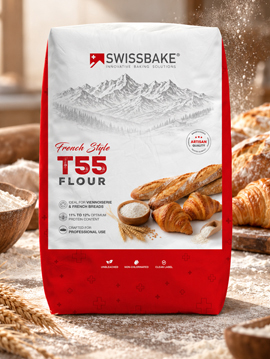
Preferment Preparation [Day 1]: In a clean container, whisk together le'sourdo® Durum Native, SwissBake® T55 Flour & water until completely smooth. Cover the container loosely and allow the preferment to ferment at room temperature, ideally 22°C to 24°C, for 24 hours.
Preferment Feeding [Day 2]: Add SwissBake® T55 Flour and water to the prepared preferment. Stir thoroughly until fully combined. Cover and allow it to ferment for 4–6 hours, or until the preferment has doubled in volume, appears domed, and is full of active bubbles. Use the preferment when it is visibly active and at peak fermentation strength.
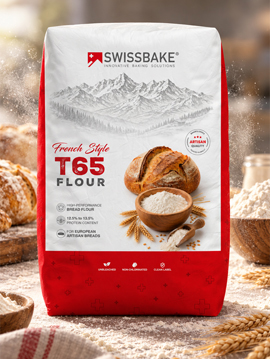
Dough Kneading: In a spiral mixer bowl, add SwissBake® T65 Flour & salt. Add the active preferment, chilled water & crumbled fresh yeast. Mix on slow speed for 4 minutes until the flour absorbs the water and the dough begins to form. Switch to fast speed and knead for 6–8 minutes until the dough becomes smooth, stretchy and comes cleanly away from the sides of the bowl.
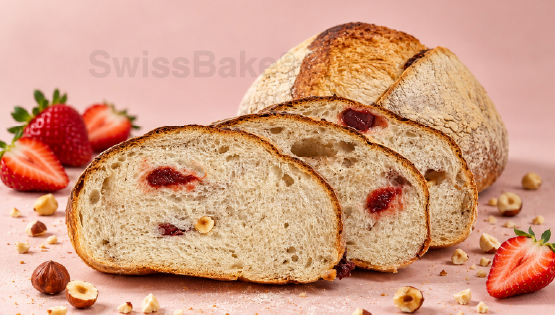
Inclusion Folding & Bulk Fermentation: Transfer the dough into a lightly oiled tub or bowl and allow it to rest for 30 minutes. Gently pull the sides of the dough and fold them into the centre. Scatter half of the drained poached strawberries & roasted hazelnuts over the dough, then fold the dough over the inclusions to incorporate them without crushing the fruit. Rest for another 30 minutes, then gently fold in the remaining strawberries and hazelnuts. Handle the dough carefully so the strawberries do not break or stain the dough red. After the second inclusion fold, allow the dough to rest for 45 minutes until it becomes puffy and full of air.
Dividing & Pre-Shaping: Turn the dough onto a lightly floured table. Divide it into equal pieces of approximately 710g each. Shape each piece into a smooth round ball, cover & allow to rest for 20 minutes. This bench rest relaxes the dough before final shaping and helps improve loaf structure.
Final Shaping & Basket Proofing: Shape each rested dough piece firmly into a round loaf or boule with a smooth, tight top. Dust the proofing baskets with flour and place each dough piece inside with the smooth side facing down and the seam facing up. Cover the baskets properly before cold retardation.
Overnight Cold Retardation: Place the covered proofing baskets in the refrigerator at 4°C for 12–16 hours overnight. This cold retardation supports flavour development, improves handling and helps the loaves hold shape during scoring and baking.
Scoring & Baking: Flip the cold loaves out onto baking paper or a peel. Dust the tops lightly with flour and make a curved cut across each loaf using a sharp blade. Load the loaves directly into a deck oven preheated to 240°C with a heavy initial burst of steam for 4–5 seconds. Lower the heat to 220°C and bake for 30–35 minutes, until the crust is deep golden brown and the loaves sound hollow when tapped on the bottom. Open the vent for the final 5 minutes of baking to ensure a thick, crisp crust.
Cooling: Transfer the baked loaves to a wire rack and allow them to cool completely before slicing. Full cooling is important because it allows the fruit pockets to set properly and helps preserve the internal crumb structure.
- Shelf Life: 3–4 days ambient, stored in paper bags or bread box

 BAKE TEMP :
 MIXING TIME :
 BAKE TIME :
 PREP TIME :